Relieve Back Pain, Reduce Stress, Improve Focus, and Feel Energized in Just 5 Minute
5-Minute Desk Yoga Break: The Simplest Way to Stay Healthy While Working
In today’s digital world, many of us spend 6–10 hours a day sitting in front of a computer. While technology has made work easier, it has also created one of the biggest health challenges of modern life prolonged sitting.
A sedentary lifestyle affects far more than your posture. Sitting for long periods can reduce circulation, tighten the hips and shoulders, weaken the core, restrict breathing, and contribute to chronic neck and lower back pain. It also increases mental fatigue, stress, and decreases productivity.
The good news?
You don’t need a one-hour yoga class to experience the benefits of yoga.
Just five mindful minutes of movement and conscious breathing can help reset your body and mind, improve posture, reduce stiffness, and restore your energy.
At Nature Pace Yoga, we believe yoga isn’t something you practice only on a mat it’s a way of living with awareness throughout the day. A short desk yoga break is one of the easiest ways to bring yoga into your daily routine.
Why Sitting for Long Hours Is Harmful
Our bodies are designed for movement, not prolonged stillness.
When we remain seated for hours, several changes begin to occur:
- The hip flexors become shortened and tight.
- The spine loses its natural mobility.
- Shoulder and chest muscles tighten, leading to rounded shoulders.
- Neck muscles become overworked, causing stiffness and headaches.
- Blood circulation slows.
- Breathing becomes shallow.
- Mental focus gradually declines.
- Stress hormones remain elevated for longer periods.
According to the World Health Organization (WHO), prolonged sedentary behavior is associated with an increased risk of cardiovascular disease, obesity, diabetes, musculoskeletal disorders, and premature mortality.
Yoga offers a practical solution by combining movement, breathing, and mindfulness.
The Yogic Perspective on Movement
The ancient yogic texts never encouraged remaining in one position for long periods.
Patanjali beautifully defines posture in the Yoga Sutras (2.46):
“Sthira Sukham Āsanam”
A posture should be steady and comfortable.
The key word here is comfortable.
When sitting creates pain, stiffness, or mental exhaustion, we have moved away from this principle.
Similarly, the Bhagavad Gita (6.17) teaches:
“Yoga becomes the destroyer of suffering for one who is balanced in eating, recreation, work, sleep, and wakefulness.”
Desk yoga is a practical application of this teaching. It helps restore balance in the middle of a busy workday.
Your 5-Minute Desk Yoga Routine
This routine includes:
✅ 5 Desk-Friendly Yoga Asanas
✅ 5 Simple Pranayama Practices
No yoga mat required.
No change of clothes.
Suitable for beginners and experienced practitioners alike.
1. Seated Cat-Cow Stretch (Chair Marjaryasana-Bitilasana)
Why Practice It?
Hours of sitting compress the spine and reduce its natural movement.
The Cat-Cow movement gently mobilizes every segment of the spine, improving flexibility and reducing stiffness.
Benefits
- Improves spinal mobility
- Relieves lower back stiffness
- Reduces neck tension
- Improves posture
- Increases circulation around the spine
How to Practice
- Sit on the front edge of your chair.
- Keep both feet flat on the floor.
- Place your hands on your knees.
- Inhale and gently arch your back while lifting your chest.
- Exhale and round the spine while drawing your chin toward your chest.
- Continue slowly with your breath.
Duration: 5–8 slow breaths.
2. Seated Spinal Twist (Vakrasana Variation)
Why Practice It?
Twisting movements help restore mobility lost from prolonged sitting and gently massage the abdominal organs.
Benefits
- Improves spinal flexibility
- Reduces stiffness
- Relieves tension around the waist
- Supports digestion
- Improves posture
How to Practice
- Sit upright.
- Place one hand on the opposite knee.
- Hold the chair behind you with the other hand.
- Twist gently from the waist.
- Keep breathing normally.
- Repeat on the opposite side.
Hold: 20–30 seconds each side.
3. Standing Side Stretch (Ardha Kati Chakrasana)
Why Practice It?
Long hours at a desk shorten the muscles along the sides of the body and reduce rib cage mobility.
Benefits
- Lengthens the spine
- Opens the rib cage
- Improves breathing
- Reduces waist tightness
- Improves posture
How to Practice
- Stand beside your desk.
- Raise one arm overhead.
- Lean gently to the opposite side.
- Keep both feet grounded.
- Repeat on the other side.
Hold: 20 seconds each side.
4. Chair Figure-Four Stretch (Chair Eka Pada Kapotasana)
Why Practice It?
The hips become one of the tightest areas during prolonged sitting.
This stretch targets the outer hips and piriformis muscles.
Benefits
- Improves hip mobility
- Relieves lower back discomfort
- Reduces piriformis tightness
- May help relieve sciatic nerve irritation caused by prolonged sitting
How to Practice
- Sit upright.
- Place one ankle over the opposite thigh.
- Keep your back straight.
- Lean forward until you feel a gentle stretch.
- Repeat on both sides.
Hold: 20–30 seconds.
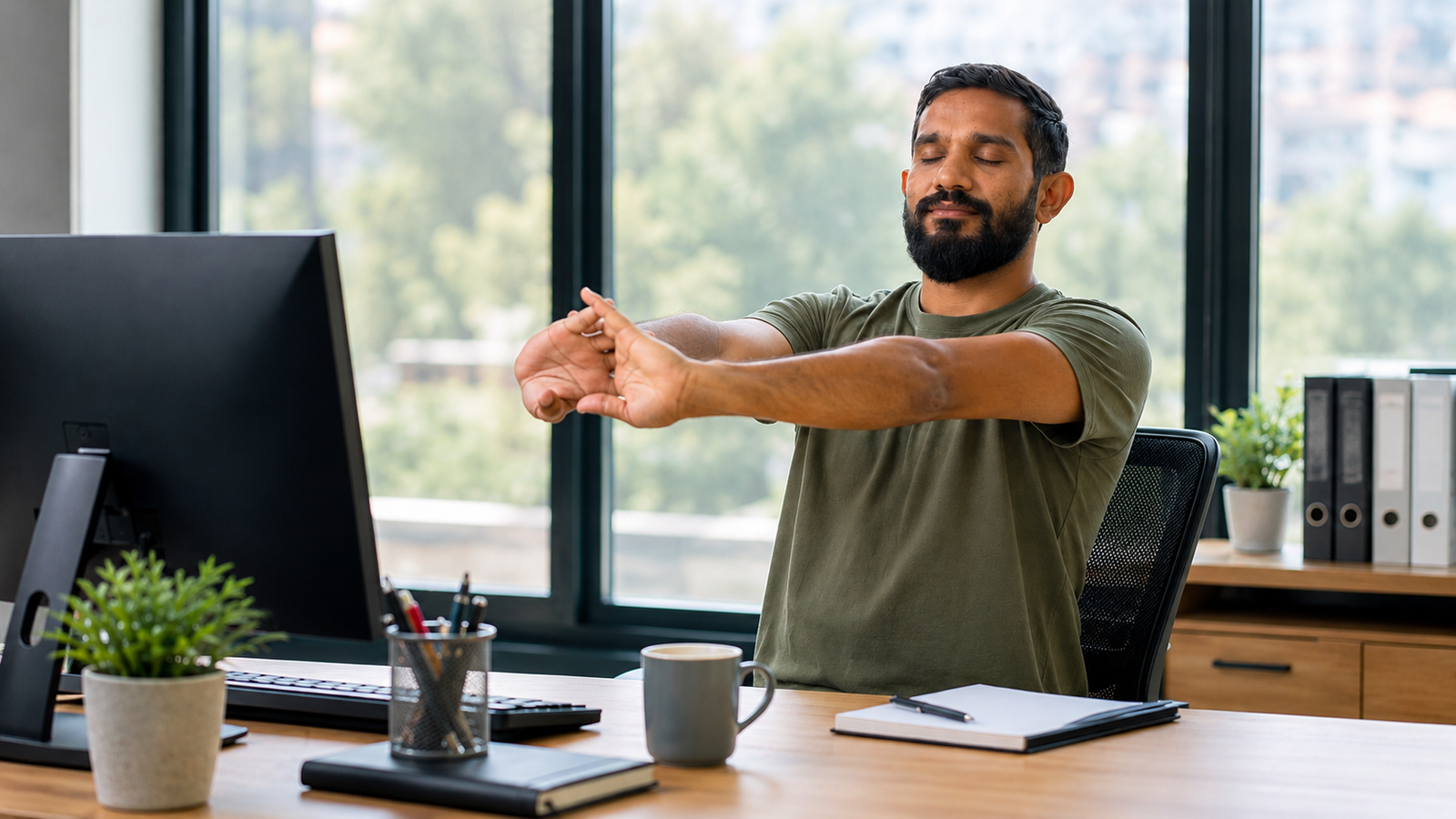
5. Standing Shoulder & Chest Opener
Why Practice It?
Typing and prolonged screen time encourage rounded shoulders and a collapsed chest.
Benefits
- Opens the chest
- Improves posture
- Relieves neck tension
- Reduces shoulder stiffness
- Encourages deeper breathing
How to Practice
- Stand comfortably.
- Interlock your fingers behind your back.
- Lift your chest gently.
- Draw the shoulders backward.
- Relax the neck.
Hold: 20–30 seconds.
Pranayama: Restore Calm in Just a Few Breaths
While movement refreshes the body, breathing restores the nervous system.
Scientific studies have shown that slow, controlled breathing improves heart rate variability (HRV), activates the parasympathetic nervous system, lowers stress hormones, and improves attention.
6. Diaphragmatic Breathing
Why Practice It?
Stress causes shallow chest breathing.
Diaphragmatic breathing encourages full use of the lungs.
Benefits
- Reduces stress
- Improves oxygen exchange
- Relaxes neck muscles
- Improves concentration
- Supports healthy posture
How to Practice
- Sit comfortably.
- Place one hand on your abdomen.
- Inhale through your nose and allow the abdomen to expand.
- Exhale slowly.
- Keep the shoulders relaxed.
Practice: 1 minute.
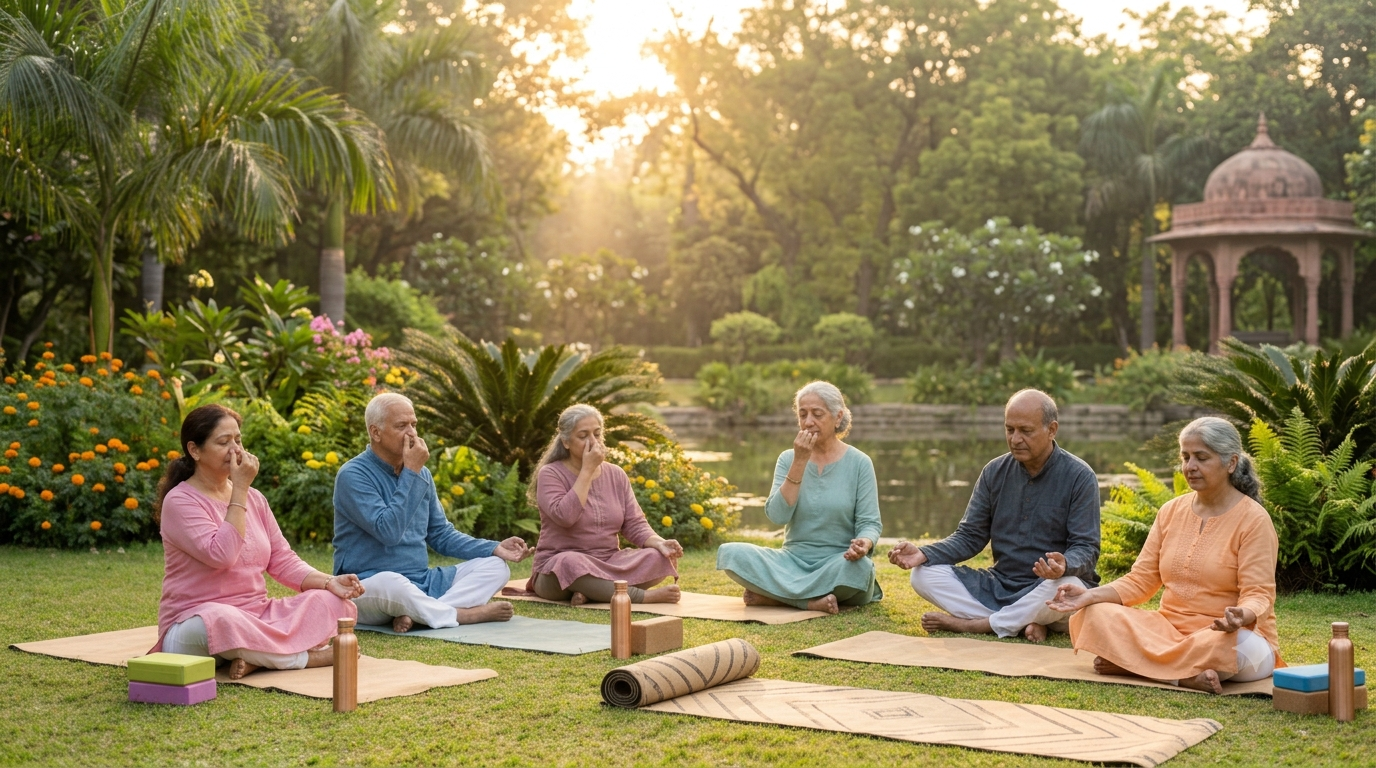
7. Nadi Shodhana (Alternate Nostril Breathing)
Why Practice It?
This classical pranayama balances the nervous system and improves mental clarity.
Benefits
- Reduces anxiety
- Improves focus
- Enhances emotional balance
- Calms the nervous system
- Promotes mental clarity
How to Practice
- Sit comfortably.
- Close the right nostril.
- Inhale through the left.
- Close the left nostril.
- Exhale through the right.
- Inhale through the right.
- Exhale through the left.
Continue for 1–2 minutes.
8. Deep Yogic Breathing (Dirgha Shwas)
Why Practice It?
Most office workers breathe only into the upper chest. Deep Yogic Breathing trains the body to use the abdomen, rib cage, and upper chest, increasing respiratory efficiency and promoting relaxation.
Benefits
- Improves lung capacity
- Increases oxygen intake
- Reduces fatigue
- Improves energy levels
- Promotes relaxation
- Enhances respiratory efficiency
How to Practice
- Sit comfortably with your spine upright.
- Inhale slowly, first expanding the abdomen.
- Continue inhaling to expand the rib cage.
- Finally, allow the upper chest to rise gently.
- Exhale slowly in reverse order chest, ribs, then abdomen.
- Keep the breath smooth, slow, and effortless.
Practice: 1 minute.
9. Box Breathing (Sama Vritti)
Why Practice It?
This rhythmic breathing pattern is widely used to regulate stress and improve concentration.
Benefits
- Improves focus
- Reduces anxiety
- Calms the mind
- Improves emotional regulation
- Enhances productivity
How to Practice
- Inhale for 4 counts
- Hold for 4 counts
- Exhale for 4 counts
- Pause for 4 counts
Repeat for 1 minute.
10. Bhramari Pranayama (Humming Bee Breath)
Why Practice It?
Bhramari is one of the most effective yogic breathing techniques for calming the mind. The humming sound creates soothing vibrations that help reduce mental tension and promote relaxation.
Benefits
- Reduces stress and anxiety
- Improves concentration
- Calms the nervous system
- Relaxes facial and jaw muscles
- Reduces mental fatigue
- Promotes emotional balance
How to Practice
- Sit comfortably with your spine erect.
- Close your eyes and relax your shoulders.
- Inhale slowly through the nose.
- Exhale while producing a soft, steady humming sound like a bee.
- Feel the vibration around the face, throat, and head.
Repeat 5–7 rounds or practice for 1 minute.
Scientific Benefits of a Daily Desk Yoga Break
Research suggests that taking short movement and breathing breaks throughout the workday can:
- Improve posture and spinal mobility
- Reduce neck, shoulder, and lower back pain
- Increase blood circulation
- Improve lung function
- Reduce stress hormones
- Enhance concentration and productivity
- Improve mood and energy levels
- Reduce mental fatigue
- Support long-term musculoskeletal health
- Improve workplace well-being
Consistency matters more than duration. Five mindful minutes several times a day can have a lasting impact on your physical and mental health.
Tips for Practicing Desk Yoga Safely
- Practice every 60–90 minutes during long work sessions.
- Move slowly and avoid forcing any stretch.
- Breathe through the nose whenever possible.
- Stop immediately if you experience pain, dizziness, or discomfort.
- If you have a recent injury, surgery, or a medical condition, consult your healthcare provider before beginning any new exercise routine.
Final Thoughts
Your desk doesn’t have to be a place where your health declines it can become a place where your well-being is supported through small, intentional habits.
A 5-minute desk yoga break is not about achieving perfect flexibility or mastering advanced postures. It is about reconnecting with your body, improving your posture, calming your mind, and creating moments of awareness in the middle of a busy day.
As yoga teaches us, transformation doesn’t always come from doing more. Often, it comes from pausing, breathing, and moving with intention.
At Nature Pace Yoga, we believe that wellness should fit naturally into your daily life. Whether you’re working from home, studying, or spending long hours in the office, these simple practices can help you feel more energized, focused, and balanced—one mindful breath at a time.
Frequently Asked Questions (FAQ)
Is desk yoga suitable for beginners?
Yes. All the practices in this routine are beginner-friendly and can be performed without prior yoga experience.
How often should I take a desk yoga break?
Aim for a 5-minute break every 60–90 minutes of continuous sitting for the best results.
Can desk yoga help with back pain?
Regular desk yoga can help relieve muscle stiffness, improve posture, and reduce discomfort associated with prolonged sitting. However, persistent or severe pain should be evaluated by a healthcare professional.
Do I need a yoga mat?
No. These movements are designed to be performed at your desk using a chair or standing beside your workstation.
Which breathing exercise is best for reducing stress at work?
Bhramari Pranayama and Nadi Shodhana are particularly effective for calming the nervous system and improving mental focus.
References
- Patanjali. Yoga Sutras, Chapter 2, Verse 46.
- Bhagavad Gita, Chapter 6, Verse 17.
- World Health Organization. Guidelines on Physical Activity and Sedentary Behaviour (2020).
- American College of Sports Medicine (ACSM). Exercise Guidelines for Sedentary Behaviour.
- American Heart Association. Physical Activity Recommendations.
- Harvard Medical School. Benefits of Deep Breathing and Mindful Movement.
- Jerath R, et al. Physiology of Long Pranayamic Breathing. Medical Hypotheses, 2006.
- Brown RP, Gerbarg PL. Sudarshan Kriya Yogic Breathing in the Treatment of Stress, Anxiety and Depression. Journal of Alternative and Complementary Medicine.