What Is Trataka?
In today’s world, our eyes move constantly from smartphones and laptops to television, books, traffic, and endless notifications. Our attention is often scattered in the same way.
Trataka offers a very different experience: instead of allowing the eyes and mind to continuously move from one object to another, we deliberately develop steadiness of gaze and attention.
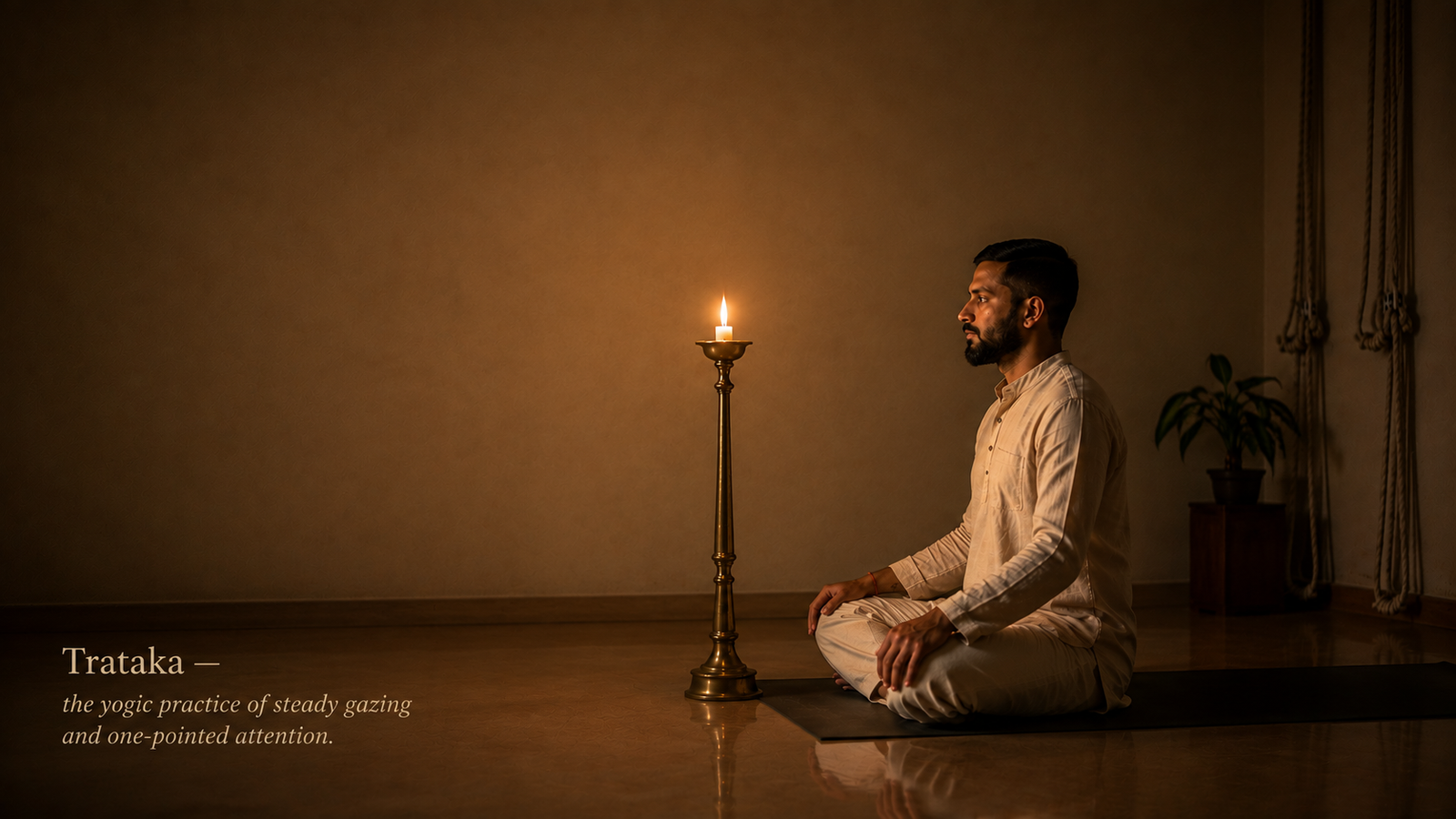
Trataka, often translated as steady gazing, is a traditional yogic cleansing and concentration practice. It involves fixing the gaze on a small, steady object with focused attention.
The most familiar modern form is candle gazing meditation, where the practitioner gently gazes at the flame of a candle. However, the classical description does not specifically require a candle. The Haṭha Yoga Pradīpikā describes gazing steadily at a small or subtle object until tears arise.
Trataka is particularly interesting because it sits at the meeting point of physical cleansing, visual awareness, concentration, and meditation.
In simple words: Trataka trains the eyes to become steady and the mind to become one-pointed.
Trataka in the Hatha Yoga Pradipika
One of the most important classical references to Trataka is found in the Haṭha Yoga Pradīpikā, attributed to Svātmārāma.
In Chapter 2, Trataka is included among the Ṣaṭkarma (Shatkarma)—the six traditional cleansing actions of Haṭha Yoga.
The text first introduces the six cleansing practices and lists:
- Dhauti
- Basti
- Neti
- Trataka
- Nauli
- Kapālabhāti
The Haṭha Yoga Pradīpikā, Chapter 2, verse 31, describes Trataka as:
“nirīkṣen niścala-dṛśā sūkṣma-lakṣyaṁ samāhitaḥ |
aśru-sampāta-paryantam ācāryais trāṭakaṁ smṛtam ||”
The verse describes looking steadily at a subtle or small object with a concentrated mind until tears arise. This is what the teachers call Trataka.
The following verse traditionally associates Trataka with the removal of eye disorders and lethargy and advises that the practice be treated as something precious.
An important point about the classical text
The Haṭha Yoga Pradīpikā does not specifically say that the object must be a candle flame. The modern practice of candle gazing is one commonly taught form of Trataka.
The essential elements in the classical description are:
Steady gaze + small object + collected attention + sustained practice.
Is Trataka a Kriya or Meditation?
Trataka is commonly called Trataka Kriya, but it is useful to understand its traditional classification.
In the Haṭha Yoga Pradīpikā, Trataka is presented as one of the Ṣaṭkarma, or six cleansing actions of Haṭha Yoga.
It should therefore not be confused with the broader term Kriya Yoga, which refers to a different set of practices and traditions.
At the same time, Trataka has an important connection with concentration (dharana) because the practitioner repeatedly brings attention back to one object.
This makes Trataka a useful bridge between the more external practices of Haṭha Yoga and the inward practices of concentration and meditation.
How to Practice Trataka
There are different approaches to Trataka. For beginners, external Trataka using a candle flame is one of the simplest ways to learn the practice.
What You Need
- A quiet, clean and dark space
- A stable candle or oil lamp
- A comfortable sitting position
- A steady surface for the candle
- Approximately 1–1.5 metres or 1 arm distance
- Minimal distractions
The flame should be positioned approximately at eye level, so that you do not have to bend or lift your head.
Step-by-Step Trataka Technique
Step 1: Prepare Your Space
Choose a quiet room with minimal distractions.
Place the candle on a stable surface. The flame should remain steady rather than flickering excessively.
Avoid strong air movement from fans or open windows.
Step 2: Sit Comfortably
Sit in Sukhasana, Vajrasana, Padmasana, or on a chair if sitting on the floor is uncomfortable.
Keep:
- The spine comfortably upright
- The head aligned with the spine
- The shoulders relaxed
- The hands resting comfortably
- The facial muscles soft
You should be able to remain still without physical strain.
Step 3: Settle the Breath
Close your eyes for a few moments.
Take several slow, natural breaths.
Allow the body to become still and bring your awareness to the present moment.
Step 4: Open Your Eyes
Gently open your eyes and bring your attention to the flame.
Look at one particular point of the flame rather than continuously moving your gaze around it.
Step 5: Maintain a Steady Gaze
Keep the eyes as steady as comfortably possible.
Traditionally, Trataka is described as gazing without blinking until tears arise. However, this should not be interpreted as forcing the eyes to remain open despite pain, burning, excessive dryness, or significant discomfort.
The goal is steadiness, not strain.
Let your breathing remain natural.
Step 6: Close the Eyes
When the eyes become tired or naturally water, gently close them.
Sit quietly for a moment.
You may notice an after-image of the flame appearing in your visual field.
Instead of trying to force the image to remain, simply observe it.
Step 7: Return to Stillness
When the after-image disappears, allow the eyes to remain closed.
Notice the stillness of the body and mind.
This quiet period is an important part of the practice.
How Long Should You Practice Trataka?
If you are new to Trataka, there is no need to begin with prolonged gazing.
A simple beginner approach is:
| Stage | Practice |
|---|---|
| Beginner | 1–2 rounds |
| Intermediate | 2–3 rounds |
| Experienced | Longer practice under appropriate guidance |
| After practice | Relax the eyes and sit quietly |
Quality is more important than duration.
Trataka should never become a competition to see how long you can avoid blinking.
The purpose is not to create eye strain. The purpose is to cultivate steadiness and awareness.
Benefits of Trataka
Trataka has traditionally been associated with both physical and mental benefits.
It is important, however, to distinguish between traditional yogic claims and what modern research currently supports.
1. Develops Concentration
One of the most obvious aspects of Trataka is its demand for sustained attention.
Instead of constantly shifting attention between different objects, the practitioner repeatedly returns to one visual point.
With regular practice, this can become a useful exercise for developing one-pointed attention.
2. Supports Mental Stillness
The movement of the eyes and the movement of attention are closely connected during the practice.
By reducing visual distractions and maintaining a single point of focus, Trataka can create a quiet environment for the mind.
This makes it useful as a preparation for meditation and concentration practices.
3. May Help Reduce Visual Fatigue
Modern research is beginning to investigate Trataka in relation to eye health and visual fatigue.
A 2026 systematic review and meta-analysis found that Trataka may help reduce visual fatigue, but the authors also emphasized that the existing evidence is limited by small studies, methodological differences, and insufficient high-quality trials.
Therefore, it is better to say that Trataka may support visual comfort and reduce perceived eye fatigue rather than claiming that it cures eye diseases or improves eyesight.
4. Encourages Mindfulness
Trataka requires you to observe one object without constantly reacting to external distractions.
This develops a quality of present-moment awareness.
Rather than trying to suppress thoughts, the practitioner keeps returning attention to the chosen object.
5. May Help Prepare the Mind for Meditation
For some practitioners, sitting with closed eyes immediately can feel challenging because the mind continues to wander.
Trataka provides an external point of focus.
After the eyes close, attention can gradually move from the external object toward the internal visual field.
This makes Trataka a useful pre-meditation practice.
6. Cultivates Patience and Mental Discipline
The practice looks simple, but maintaining a steady gaze requires discipline.
The eyes want to move.
The mind wants to wander.
The body may want to adjust its position.
Each time you notice this and gently return to the practice, you are training the quality of attention and steadiness.
Traditional Benefits vs Modern Evidence
| Traditional Yoga Perspective | What Modern Evidence Suggests |
| Cleansing practice for the eyes | May support visual comfort |
| Helps remove lethargy | Requires further research |
| Develops steadiness of attention | Concentration is a central feature of the practice |
| Supports one-pointedness | Consistent with its attentional demands |
| Preparation for inward practices | Commonly used as a concentration practice |
| Supports eye wellness | Evidence is promising but still limited |
The Haṭha Yoga Pradīpikā makes stronger traditional claims about eye disorders and lethargy, but these should be understood within the context of classical yogic literature rather than presented as modern medical guarantees.
Trataka for Screen Users
Modern lifestyles have created a very different visual environment from the one in which traditional yoga developed.
Many people spend hours looking at:
- Smartphones
- Computers
- Tablets
- Television
- Digital documents
- Online learning platforms
This makes practices involving visual awareness particularly interesting.
However, Trataka should not be considered a replacement for healthy screen habits.
If you spend long hours working on a computer, combine your yoga practice with:
- Regular screen breaks
- Conscious blinking
- Appropriate lighting
- Comfortable viewing distance
- Good posture
- Adequate sleep
- Professional eye examinations when needed
Trataka may be included as part of a broader wellness routine, but it should not be used as a substitute for medical care.
Precautions While Practicing Trataka
Trataka is simple, but more intensity does not mean more benefit.
Keep these precautions in mind:
- Do not force yourself to keep the eyes open.
- Stop if you experience pain or significant irritation.
- Do not stare at a flame from an uncomfortable distance.
- Keep the candle securely placed to avoid fire hazards.
- Avoid practicing when you are extremely tired.
- Do not treat Trataka as a treatment for an eye disease.
- People with existing eye conditions should seek appropriate advice from an eye-care professional before practicing prolonged gazing.
- If the practice causes persistent discomfort, stop and reassess your technique.
A 2026 systematic review specifically noted that current research on Trataka and eye health remains limited and that stronger clinical studies are needed.
Common Mistakes in Trataka
❌ Forcing the Eyes Not to Blink
The classical instruction is often interpreted too literally.
The goal is not to torture the eyes by resisting every blink.
✅ Instead:
Maintain a steady gaze while remaining relaxed. If significant discomfort develops, close the eyes.
❌ Staring Aggressively at the Flame
Trataka is not an intense staring competition.
✅ Instead:
Keep the gaze steady but relaxed.
❌ Practicing for Too Long
Longer practice does not automatically mean better practice.
✅ Instead:
Start with a short duration and gradually develop your capacity.
❌ Expecting Better Eyesight Immediately
Trataka is often promoted online as a way to “improve eyesight.”
This is an oversimplification.
Current research does not justify presenting Trataka as a cure for refractive errors or eye diseases. The recent systematic review found potential benefits for visual fatigue but concluded that the evidence remains inconclusive.
Trataka and the Yogic Path
One of the most beautiful aspects of Trataka is that the practice begins with something very simple:
Looking at one point.
But the deeper practice is not merely about the flame.
At first, you are learning to steady the eyes.
Then you begin to steady the attention.
Eventually, the practice can become an opportunity to observe the mind itself.
This reflects an important principle of yoga: the journey from external awareness toward internal awareness.
Trataka can therefore be approached not simply as an eye exercise, but as a practice of attention, steadiness and self-awareness.
Frequently Asked Questions About Trataka
What is Trataka in yoga?
Trataka is a traditional yogic practice of steady gazing at a small or fixed object. It is described in the Haṭha Yoga Pradīpikā as one of the six Ṣaṭkarma cleansing practices.
Is Trataka the same as candle gazing meditation?
Not exactly.
Candle gazing is one popular form of Trataka, but the classical Haṭha Yoga Pradīpikā describes gazing at a small or subtle object rather than specifically requiring a candle.
Is Trataka a Shatkarma?
Yes. The Haṭha Yoga Pradīpikā includes Trataka among the six Ṣaṭkarma.
Can Trataka improve eyesight?
It should not be promoted as a treatment for refractive errors or eye diseases. Emerging research suggests possible benefits for visual fatigue, but the evidence is still limited and inconclusive.
How long should beginners practice Trataka?
Beginners can start with short, comfortable sessions rather than attempting prolonged gazing. The priority should be relaxation, steadiness and consistency—not duration.
Can I practice Trataka every day?
A short, comfortable practice may be incorporated into a regular yoga routine. However, if you experience eye irritation, pain, headaches, or persistent visual discomfort, stop the practice and seek professional advice.
Can Trataka help with concentration?
Concentration is one of the central purposes of the practice. By keeping attention on one visual object and returning to it whenever the mind wanders, Trataka provides a structured way to train sustained attention.
Final Thoughts
Trataka is a beautiful example of how traditional yoga transforms a simple action into a deeper practice of awareness.
You begin by looking at a single point.
Then you learn to keep the eyes steady.
The mind gradually becomes less scattered.
And eventually, the practice becomes less about the object you are looking at and more about the quality of attention with which you are looking.
The Haṭha Yoga Pradīpikā places Trataka among the traditional Ṣaṭkarma and describes it as steady gazing at a subtle object until tears arise.
Today, Trataka can be approached as a traditional yogic practice for concentration, visual awareness and preparation for meditation, while keeping modern scientific evidence and individual safety in mind.
The real practice is not simply to keep your eyes open.
It is to learn how to remain steady.
🧘 Practice Trataka With Guidance
If you are new to yogic cleansing practices, learning Trataka from an experienced yoga teacher can help you understand the technique without unnecessary strain.
At Nature Pace Yoga, we believe yoga is more than physical exercise—it is a way of developing awareness, balance and a healthier relationship with the body and mind.
Start gently. Practice consistently. Let steadiness become part of your practice.